9 min read
2-2-3, 2-2-5-5 and Week-On/Week-Off: Common Parenting Schedules Explained
Compare the 2-2-3 custody schedule, 2-2-5-5 rotation, and week-on/week-off plan with a sample timeline for each to find what fits your family.
The OFWSync team
Quick Summary: Three common 50/50 custody rotations (2-2-3, 2-2-5-5, and week-on/week-off) trade off between parent contact and household stability, with the 2-2-3 maximizing contact for young children and the week-on/week-off minimizing handoffs for teens. The 2-2-5-5 sits in the middle, locking in fixed weekdays so school routines stay predictable while full weekends rotate. All three deliver equal overnights over two weeks, so the right pick comes down to the child's age, temperament, and how far apart the parents live. Once the plan is set, syncing the schedule into a shared calendar keeps both homes on the same page without manual copying.
Picture two parents, two homes, one school-age child, and a court order that says equal time. Three options sit on the table: a 2-2-3 custody schedule, a 2-2-5-5 parenting schedule, and week-on/week-off. Each one adds up to 50/50 over two weeks, but the days your child wakes up in your house can look wildly different. That's the problem: "equal" on paper hides big differences in school-week stability, handoffs, and holidays. This guide compares all three, shows a two-week example of each, and matches each schedule to common ages. Your court order or parenting plan governs; use this as a planner to understand the options before you talk them through with your co-parent and your attorney.
Table of Contents
- How the 2-2-3 Rotation Actually Plays Out
- How the 2-2-5-5 Rotation Splits the Week
- How the Week-On / Week-Off Rotation Works
- Choosing Between 2-2-3, 2-2-5-5, and Week-On / Week-Off
- Putting Any of These Rotations on Your Family Calendar
- Frequently Asked Questions
- Conclusion
How the 2-2-3 Rotation Actually Plays Out
In a 2-2-3 custody schedule, your child spends two nights with you, two with the other parent, then three with you. Week two mirrors it, so the three-day block switches homes. Nobody goes more than three days without seeing either parent.
The 2-2-3 Pattern in One Two-Week Grid
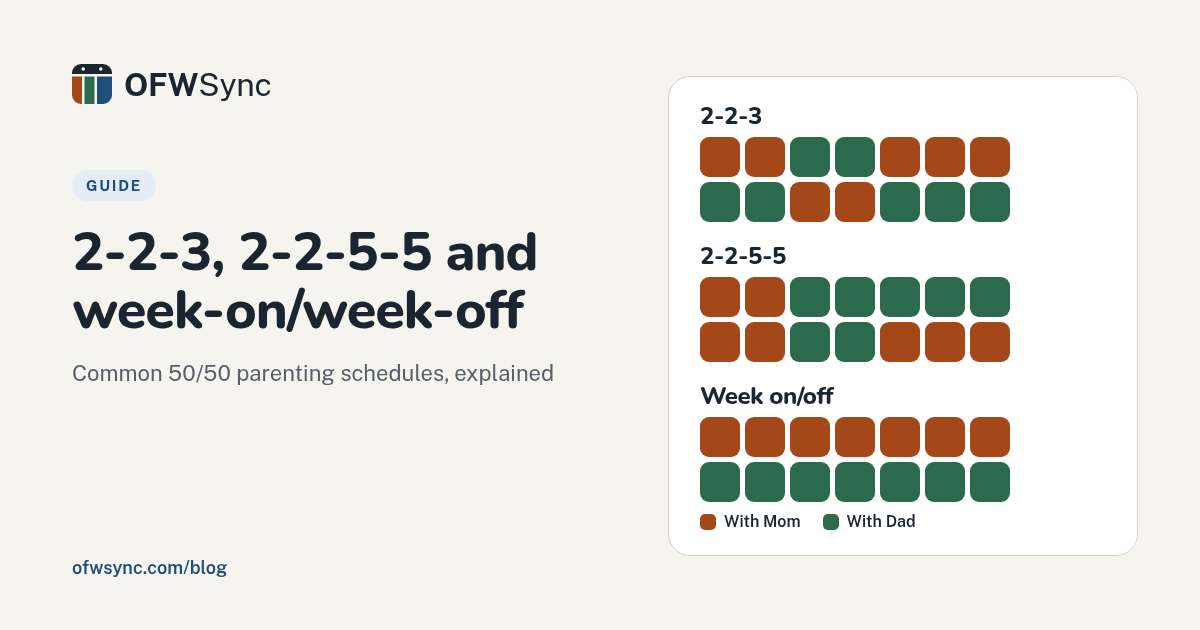
Here's a two-week example starting on a Monday, with M = Mom and D = Dad:
| Day | Mon | Tue | Wed | Thu | Fri | Sat | Sun |
|---|---|---|---|---|---|---|---|
| Week 1 | M | M | D | D | M | M | M |
| Week 2 | D | D | M | M | D | D | D |
Count it up: seven overnights each across the two weeks, true 50/50. Notice what changes. The three-day block flips each week, and so do the weekdays. Monday belongs to Mom this week and Dad the next, which is why a shared calendar beats a paper printout taped to the fridge.
Pros, Cons, and Best-Fit Ages for 2-2-3
| Pros | Cons | Best-Fit Ages |
|---|---|---|
| No long stretches apart; both parents see the child every few days | More handoffs than any other 50/50 plan, usually three per week | Toddlers and young kids, roughly 2 to 8 |
| Both parents stay involved with school and activities | Weekday homes alternate, which can blur routines | Works best when parents live close and cooperate |
| Even overnights, no "visitor" parent | Frequent transitions can tire some children | Less steady for kids who need one school-week base |
Compared with a 2-2-5-5 parenting schedule, the 2-2-3 front-loads contact but costs more exchanges, and family law attorneys note the trade-off directly.
How 2-2-3 Looks on a Shared Calendar
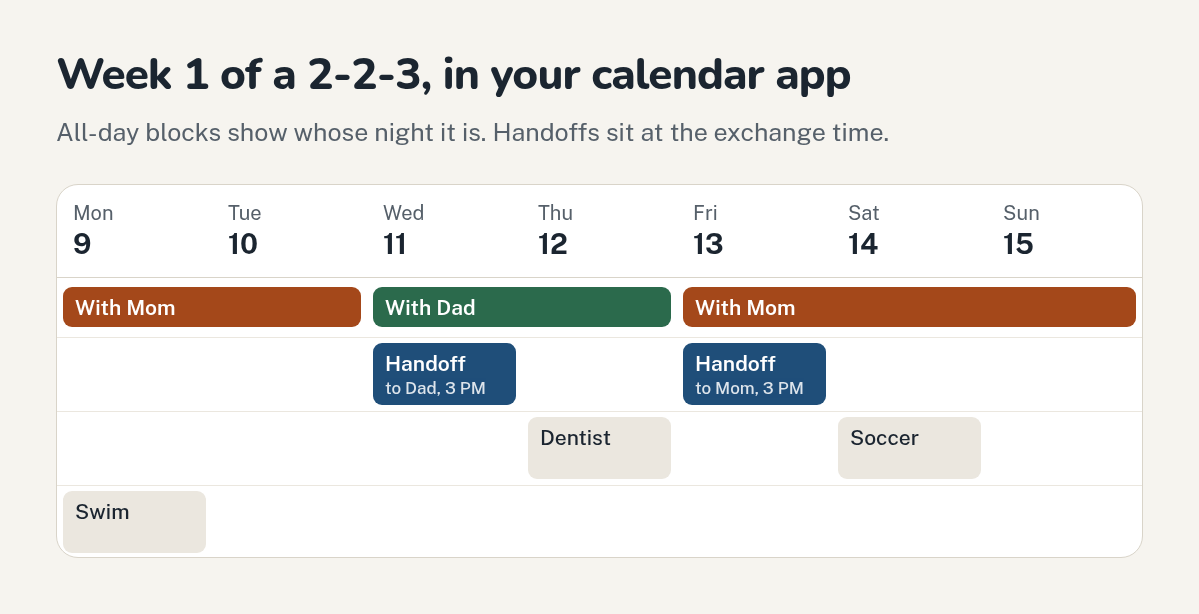
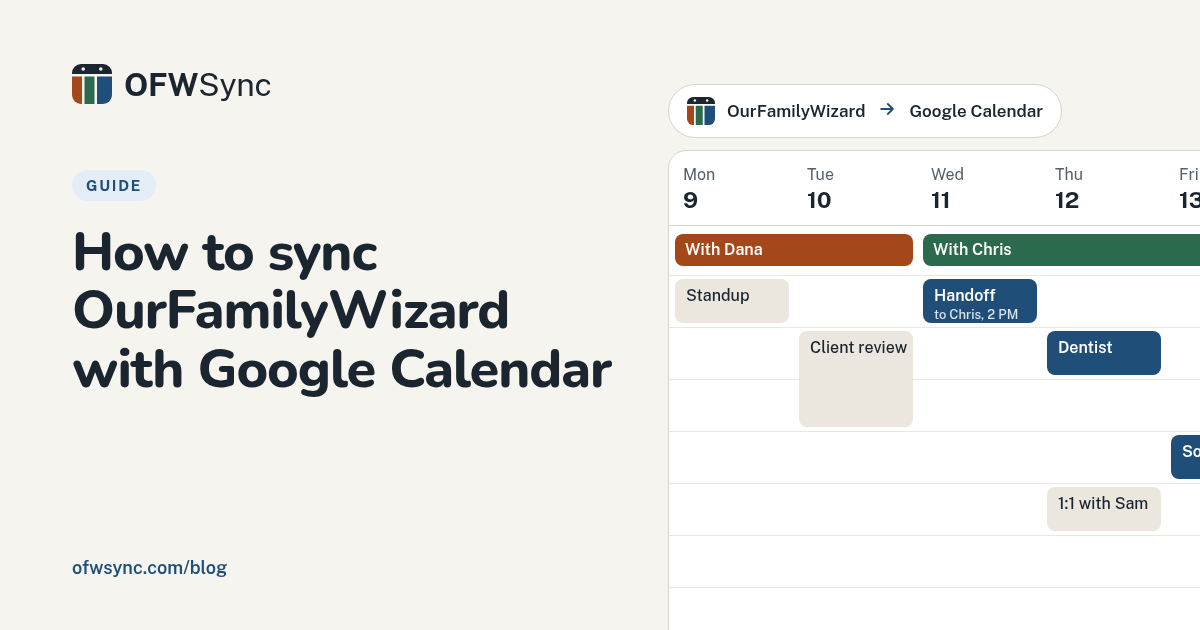
On a shared calendar, each day appears as a "With Mom" or "With Dad" all-day block, plus handoff events on switch days. A synced calendar shows this in Google or Apple automatically; see how to sync OurFamilyWizard with Google Calendar.
How the 2-2-5-5 Rotation Splits the Week
In a 2-2-5-5 parenting schedule, each parent gets the same two weekdays every week and the pair alternates five-day stretches. You keep, say, Monday and Tuesday; the other parent keeps Wednesday and Thursday. Weekends rotate, so one parent holds Friday through Sunday in week one and the other holds it in week two.
The 2-2-5-5 Pattern in One Two-Week Grid
Say Mom has Monday and Tuesday, Dad has Wednesday and Thursday. The grid looks like this:
| Week | Mon | Tue | Wed | Thu | Fri | Sat | Sun |
|---|---|---|---|---|---|---|---|
| Week 1 | M | M | D | D | D | D | D |
| Week 2 | M | M | D | D | M | M | M |
Count the overnights: seven each across the two weeks, true 50/50. Weekends always stay in one home, and the longest a child goes without seeing either parent is five nights.
Pros, Cons, and Best-Fit Ages for 2-2-5-5
| Pros | Cons | Best Ages |
|---|---|---|
| Same weekdays every week, so school routines and activities stay predictable | Each parent goes without a weekend every other week | School-age kids, roughly 6 to 12 |
| Fewer handoffs than 2-2-3, about two a week | Kids go up to five nights without seeing one parent | Also workable for older preschoolers |
| Full weekends in one home, no mid-weekend swaps | Fewer touchpoints than the 2-2-3 custody schedule offers | Teens who want fewer transitions |
The five-day block is the trade-off. Family law attorneys often suggest this rotation over 2-2-3 for school-age children because it cuts the shuffling, and one Texas family law firm notes each parent holds fixed weekdays plus alternating weekends.
Handling the Mid-Week Handoff in 2-2-5-5
Exchanges always fall on the same days (in the example above, Monday, Wednesday, and Friday), so they're easy to plan around. When the switch lands on a school day, plan the handoff at pickup or drop-off: one parent drops the child at school in the morning, the other picks up in the afternoon, and nobody has to meet face to face. Log any approved trades in writing; a synced calendar view helps both homes see the change without extra texts. The parenting plan governs, so confirm any swap in writing with your co-parent first.
How the Week-On / Week-Off Rotation Works
Week-on/week-off is the simplest 50/50 plan: one parent has every overnight for a full week, then the other parent takes the next seven days. Exchanges happen once a week, usually on the same day and time.
The Week-On / Week-Off Pattern in One Two-Week Grid
Picture a plain calendar. Week one belongs to Mom, week two to Dad, then it flips. That's the whole pattern.
| Week | Sun | Mon | Tue | Wed | Thu | Fri | Sat |
|---|---|---|---|---|---|---|---|
| Week 1 | M | M | M | M | M | M | M |
| Week 2 | D | D | D | D | D | D | D |
Count the overnights: seven each across the two weeks, true 50/50. One exchange per week, and it never moves.
Pros, Cons, and Best-Fit Ages for Week-On / Week-Off
| Strengths | Drawbacks | Best Fit |
|---|---|---|
| One exchange a week, so there is little shuffling and no mid-weekend split | Seven straight days without seeing the other parent, which feels long for young children | Teens and older school-age kids who can handle a week apart |
Because it's so steady, week-on/week-off works well for parents with demanding work schedules, as long as both homes are close enough to the child's school. It's less kind to toddlers, who often struggle with a full week between contacts.
Variations: Mid-Week Visits
Many families soften the rotation with a mid-week visit, so the off-duty parent sees the child for dinner or an overnight around day four. A written plan should say who does the mid-week driving. Once your parenting plan is set, a sync tool keeps your phone calendar matching the plan automatically.
Choosing Between 2-2-3, 2-2-5-5, and Week-On / Week-Off
All three rotations hit true 50/50 over two weeks. What changes is how often your child switches homes and how long each stretch lasts. Once you see them side by side, the right fit usually becomes obvious.
Side-by-Side at a Glance
| Schedule | Handoffs per 2 Weeks | Longest Stretch Away | Best Age Fit |
|---|---|---|---|
| 2-2-3 | 6 | 3 nights | Toddlers to age 8 |
| 2-2-5-5 | 4 | 5 nights | School-age, 6 and up |
| Week-on/week-off | 2 | 7 nights | Teens, 12 and up |
Every plan delivers seven overnights per parent over two weeks. The trade is simple: more handoffs mean more contact, fewer handoffs mean longer stretches and calmer weeks.
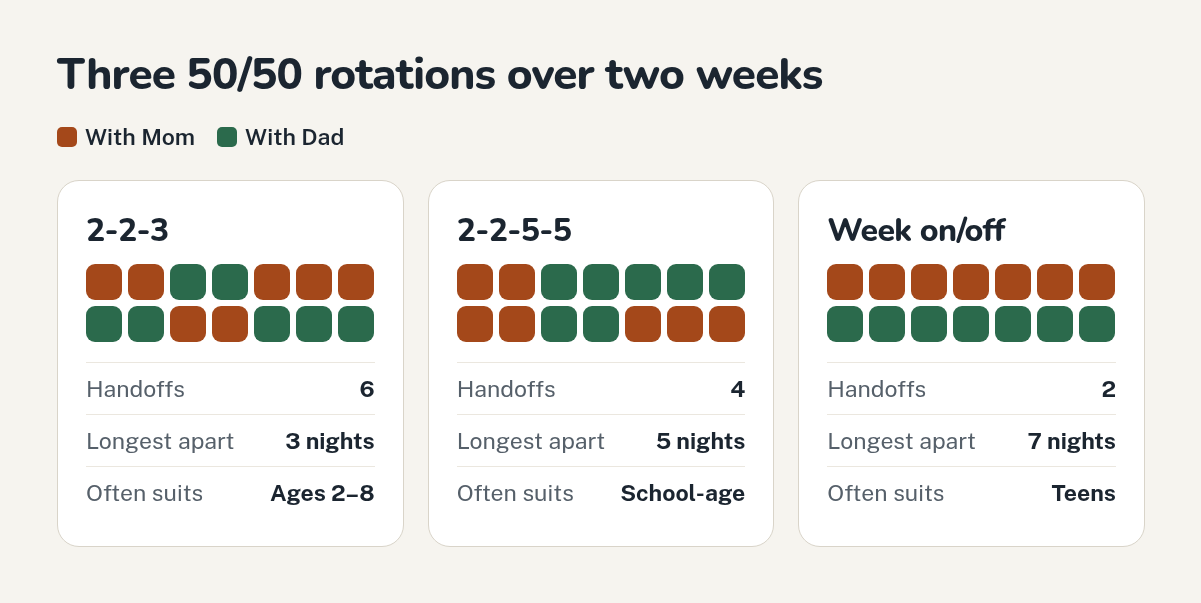
Which Rotation Fits Which Family
Pick 2-2-3 if your child is young and needs frequent contact with both parents. Choose 2-2-5-5 once school routines matter, because weekdays never change. Go week-on/week-off for teens who handle a week apart without trouble. Match the plan to your child's temperament, not just your work schedule.
Handling Holidays, Breaks, and Trades
Most parenting plans override the rotation for holidays, so the schedule pauses and resumes cleanly. Summer breaks often run week-on/week-off even when the school year follows 2-2-5-5. Approved trades shift days; keep the written plan as your source of truth, and make sure your calendar reflects what the order actually says. If you're unsure how a holiday provision applies, ask your attorney.
Putting Any of These Rotations on Your Family Calendar
A written plan only works when both parents can see it at a glance. That means the calendar, not the parenting plan PDF, is what you actually live by day to day.
What Each Parent Should See on Their Calendar
Each parent needs three things visible: which home the child sleeps at tonight, when the next handoff happens, and any trades or exceptions the other parent approved. All-day "With Mom" or "With Dad" blocks work well for overnights. Add short handoff events with time and place so pickup confusion disappears.
One Lightweight Way to Mirror the Schedule
Instead of copying every overnight by hand, some families sync their shared parenting calendar straight into Google, Apple, or Outlook, so updates flow in automatically. If you're comparing tools, our guide to the best co-parenting calendar apps breaks down the options. Whichever route you pick, check the next seven days every Sunday night.
Whichever rotation you choose, the plan on paper only helps if the calendar matches. OFWSync syncs your OurFamilyWizard schedule into Google, Apple or Outlook automatically. Start your free trial.
Frequently Asked Questions
Q1: What is a 2-2-3 custody schedule and how does it work?
Two nights, two nights, then three; the three-day block flips homes each week.
Q2: How does a 2-2-5-5 parenting schedule work in shared custody?
Each parent keeps the same two weekdays; five-day blocks that include the weekend alternate, keeping school routines stable.
Q3: What is the week-on/week-off custody schedule?
One parent keeps a full week, then homes swap, with one exchange a week.
Q4: Which parenting schedule is best for toddlers?
Often the 2-2-3, because no separation exceeds three nights. Your parenting plan and your child's needs decide.
Q5: How do you put a co-parenting schedule on a shared calendar?
Add all-day "With parent" blocks plus handoff events with time and place.
Q6: Can I sync an OurFamilyWizard schedule to Google or Apple Calendar?
Yes. OFWSync delivers a read-only feed, so there's no manual copying.
Q7: What are the most common custody schedule patterns used by courts?
Alternating weekends, 2-2-3, 2-2-5-5, and week-on/week-off.
Q8: How do parents handle custody schedule swaps during holidays?
Holiday provisions override the rotation; confirm any trade in writing.
Conclusion
All three rotations deliver true 50/50 over two weeks; what differs is the rhythm. The 2-2-3 custody schedule maximizes contact and suits young children, 2-2-5-5 keeps school routines steady, and week-on/week-off offers the fewest handoffs for older kids. Match the rotation to your child's age and temperament, then let holidays and written trades override it as needed. A court order or parenting plan governs, so run any change past your attorney first. And once the plan is set, the shared calendar is what you live by, so keep both homes reading from the same source of truth.